
Conversations ….

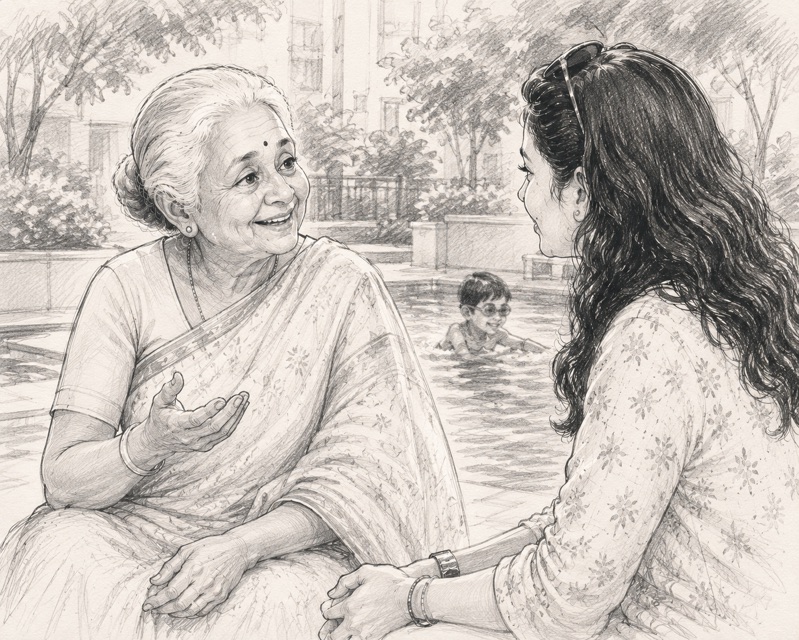
I recently met an 84-year-old lovely lady by the pool at a friend’s apartment complex. I was sitting there watching my friend’s son swim when she approached me and asked if she could sit next to me.

Neither of us asked the other’s name.

We spent the next hour together, and I found myself completely fascinated as I listened to the stories of her life.

Although her family was originally from Kerala, she was born and raised in Chennai before moving to Noida, where she spent most of her adult life.

She studied for a BSc in Mathematics and got a job with the Department of Defence. But life had other priorities for her. On her way to her very first day at work, her husband told her she could not work. She resigned that very same day, against her wishes.

She began tutoring children up to the sixth grade. She smiled as she said she wasn’t like her sister, who had completed an MSc in Aviation Medicine. I didn’t even know such a field existed. “Had I studied more,” she said, “I would have taught students until the twelfth grade.”

She also told me that when she wanted to pursue her graduation, her parents strongly opposed it. It was her uncle who intervened, making it possible for her to board the only train that ran from Coimbatore to Chennai at the time—the Blue Mountain Express, a steam engine train in the 1960s. She travelled alone into her future.

As she looked around the apartment complex, she said, “I wish I had worn salwar kameez more often. I became so used to sarees. I should have switched earlier in life. It only takes a few minutes to wear a saree, but salwar kameez and trousers are simply easier.” Back in day she wore half sarees and had to transition to a proper saree in her teens.  

She came from a family of eleven children. Speaking about one of her sisters, she said she had passed away a couple of years ago because she had become too dependent on her husband. “That is why a person should always remain independent,” she said. “Look at me—I go for my walks every day. The only thing I can’t do is book an Uber, but I should learn.”

Now she spends her time between her daughter who lives in the US and her son based in India.  She was excited to meet her family in Kannur for a family reunion the following week. 

There was something about her that stayed with me. She was resilient, steadfast, quietly bold and deeply inspiring.

The reason I write about her is not because she was 84. It is because, at 84, she was still looking forward to life. She was still curious, still learning, still embracing independence, and still finding joy in meeting strangers.

Before we parted, “Keep yourself busy,” she said. “Stay occupied. Meet people.”

Sometimes conversations happen when you give them and when someone simply asks if the seat next to you is free.

Comments

Popular posts from this blog

itadaki Mas - The Japanese thank you for the meal at the table .

 頂きます(いただきます) to receive; to get; to accept; to take (humble). This explains why you say it before you eat. You're "receiving" food, after all. Itadakimasu (and its dictionary form itadaku 頂く いただ ) comes from Japan's roots in Buddhism, which teaches respect for all living things. I was introduced to itadaki masu by my Japanese friend Etsuko who had dinner with us at my home in Lonavala. It turned out that Etsuko had a sudden pasta craving and wanted me to cook some for her.  Before our meal, Etsuko thanked my mother with clasped palms as a gesture of gratitude, for the hands that cook our meals. Etsuko then introduced us to the concept of itadak imasu and also told us that this meant saying thank you to everyone in the chain of food distribution - bringing to mind the farmer and his family, the truck driver who drives the produce to the city and so on . A second of thought is given to each person in this chain of bringing food to our table. At that point, I remember b...

Are you a people pleaser?

A people pleaser maybe some one who just cannot say no, at the cost of making other people happy. It could mean that you want to avoid conflict. Most often than not people pleasing is simply exhausting. Where does people pleasing come from? Sometimes from the need to be accepted . Fear of rejection is a driver that makes most of us become people pleasers. A constant sense to indicate that you may be hurting the other person by saying no. People pleasing would mean constantly allowing people to cross your boundaries. It is therefore important to reflect and understand what your boundaries are . While it is seen as a nice trait in people at a superficial level , it can be equally damaging. You may find people taking you for granted. You may find yourself physically or emotionally drained. You may find yourself ending up in an abusive situation. Being nice to people, may not always be a good at the cost of your peace and the rate of emotional depletion. Learning to say No doesn’t come int...

Be like the moss :)

  Have you ever noticed "moss" ?Yes,  the green stuff that grows all over . Have you ever paid attention to the moss growing on a rock or a wall . Where I grew up, there is a lot of moss when it rains. It always makes the wall look colorful with different shades of green. Does the moss know it doesn’t get any attention from us ? Does it care ? Perhaps not. It continues to provide a great habitat and is a source of food for many insects. Did you know that the moss helps the ecosystem perform effectively ? It plays quite an interesting role in retaining water, stabilizing the ground and removing CO2. In World War II, Sphagnum  moss  was used as a bandage to stop bleeding wounds and it had some antibiotic effects. So some mosses have healing properties too.   Now does the moss know that it is such a critical part of the ecosystem and still does not get the attention it deserves. ? But does it stop thriving or does it selflessly continue doing its jo...