 \
\
Over the past 10 days, it has occurred to me that people have been asking, “Millennials chup baithe the?” or “Millennials ne apne time mein kiya kya?”
The honest answer, as a millennial, is: “Not Enough.” We were not a generation of revolutionaries on the scale that your generation has been.
We are a generation that grew up at a time, when life, from our perspective, seemed relatively normal. Personally, I do not remember an incident that demanded a collective voice of action. But in hindsight, perhaps we could have spoken up. We were taught to put our heads down, listen to our elders and keep quiet. Don’t talk back. Respect anyone who was older than you.
We could not question our teachers for fear of being reprimanded. Our biggest act of rebellion was coming home at 6:15 p.m. when our curfew was 6:00 p.m.
We had to study, find a job and live our lives. Never challenge the status quo. That’s why many of us didn’t even know how to negotiate a salary or ask our bosses for leave.
We were rebels without a cause in small ways, but never for a national cause. If a man touched a woman inappropriately on a train, it was often normalised. We did not learn to speak up for ourselves.
We kept our opinions to ourselves and discussed them only with like-minded people. As girls, we did not always have the freedom to wear what we wanted or show skin, even if we wanted to. We were expected to be modest.
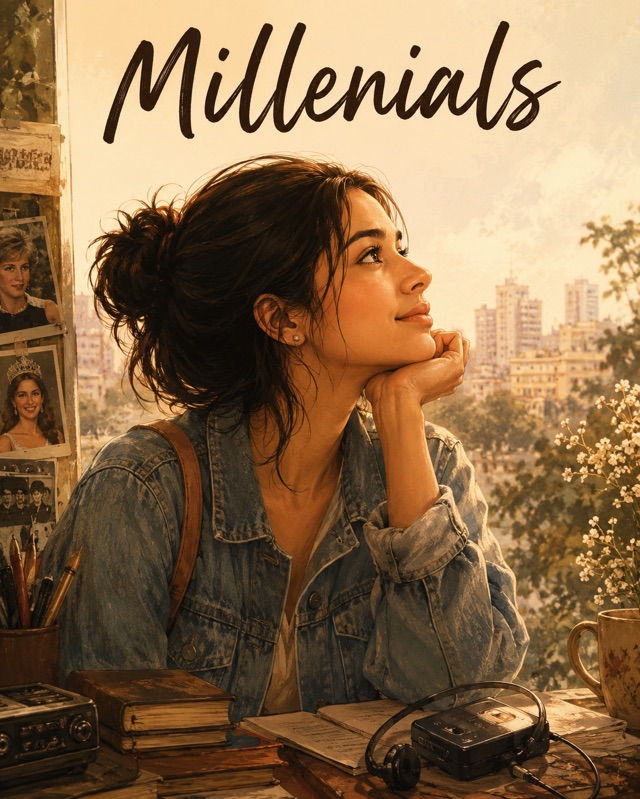
Our childhood was shaped by Chhayageet, Fauji, The Jungle Book and the Sunday evening movie on Doordarshan. That was our window to the outside world.
We recorded songs from FM radio onto cassette tapes and listened to them over and over again. We were fortunate enough to own a VCR, which meant borrowing videotapes from the local video library.
That was the extent of our exposure, especially if you grew up in a small town. Many girls who turned 18 were already preparing to get married by the age of 20 or 21. That was simply the way of life.
Progressive parents who understood the importance of educating their daughters encouraged them to study. I was fortunate to be brought up in a fairly liberal and open-minded family. I didn’t face many of the restrictions that some of my friends did.
With our limited exposure, the goal was simple: graduate, complete a postgraduate degree if possible, do something meaningful with your life and earn a living.
When we entered the workforce, we worked hard and listened to our bosses. We weren’t a confrontational generation. Looking back, I don’t think it was because we couldn’t differentiate between right and wrong—it was simply the societal mindset we grew up with.
Our thinking gradually evolved through our teachers, professors, peers and workplaces. There was no social media. Only newspapers, magazines and mainstream television.
We grew up watching Sushmita Sen and Aishwarya Rai break barriers by becoming Miss Universe and Miss World. Beauty standards were different then. Most of us owned just one makeup item—a lipstick. There were no GRWM videos or beauty influencers.
We also grew up admiring women like Mother Teresa and Princess Diana. I still remember how deeply Princess Diana’s death affected people around the world.
We clipped newspaper editorials, cut out magazine articles and carefully pasted them into scrapbooks. That was how we collected ideas that inspired us.
Going abroad was a distant dream. Even convincing our parents to let us study in another city often required an act of rebellion. The world felt much bigger and much farther away.
So, to the generation that found its voice and refuses to be silenced—kudos.
Every generation is shaped by the times it grows up in. Ours taught us to endure. Yours has learned to question. And perhaps the world needs both.
Comments
Post a Comment